Explore how masking at work drains focus and fuels burnout, and discover practical ways to manage overwhelm and protect your energy.
Alternative formats available: Listen | Watch
After a day of back-to-back meetings and juggling tasks, you leave work feeling completely drained, yet to everyone else, you look perfectly composed. For many neurodivergent individuals that hidden exhaustion comes from masking—the constant effort to appear “neurotypical” at work. While it may help you fit in or avoid judgment, this kind of masking takes a heavy toll, draining energy, and fueling burnout. This article looks at why masking is so exhausting, what’s happening in the brain in this state, and how recognizing overwhelm as feedback can help you protect your mental well-being.
What is Masking?
Masking means suppressing or compensating for neurodiverse traits to meet the social and professional expectations of a neurotypical world. It’s the quiet effort to stay regulated on the outside even when your attention and energy feel scattered.
At work, masking might look like:
Nodding along in meetings while your mind races ahead or drifts away
Tapping your foot under the desk
Self-critiques
Taking on extra work just to prove you’re capable, often at the expense of rest
Masking can look different depending on the situation. Below are some common ways it might show up for neurodivergent individuals in everyday workplace settings:
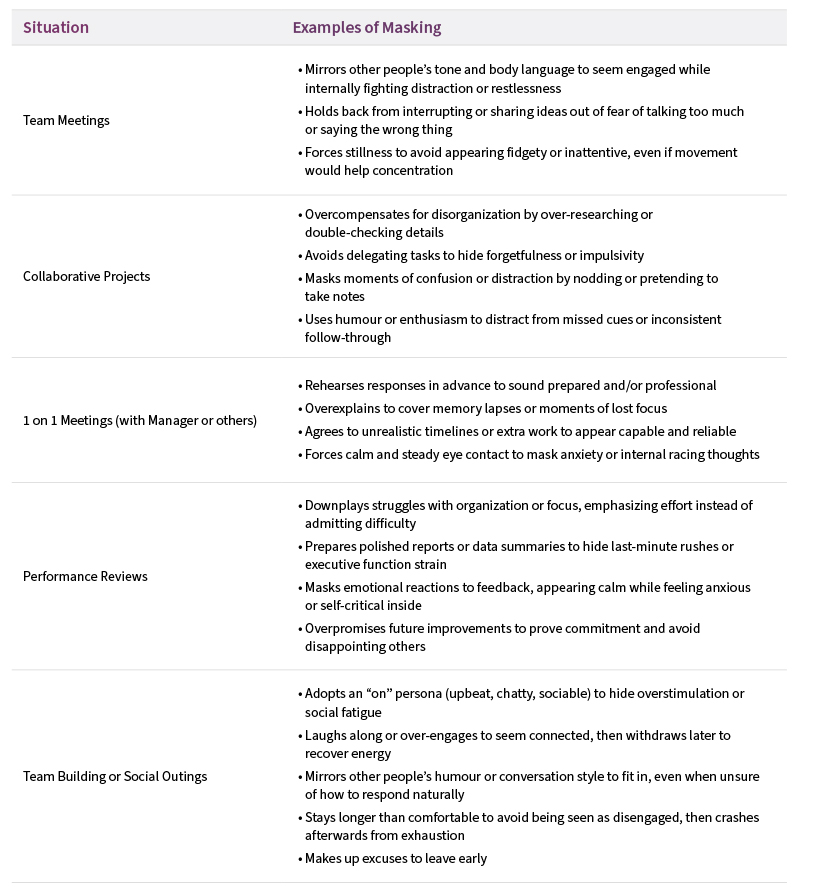
On paper, this can look like diligence and competence. In reality, it’s often exhaustion disguised as control. Neurodivergent folks may spend so much mental energy managing how they come across or trying to meet workplace expectations that it can reduce the energy available for work tasks. Over time, this kind of constant self-correction chips away at both energy and confidence.
Masking is often mistaken for learned professionalism, but it’s really a survival strategy. Many people learn it early in life as a way to avoid criticism or rejection. In workplaces where productivity and precision are valued above flexibility and creativity, masking can feel like the only way to belong.
Masking vs Managing
Some forms of masking can be helpful rather than harmful. Many people develop practical coping strategies that support focus and daily functioning, not to hide who they are but to keep their lives running smoothly. These adaptive habits can make it easier to manage symptoms and stay organized. These habits may include practicing active listening during conversations and meetings, using reminders to stay on track, writing things down as they come to mind, or keeping a tidy workspace to reduce distractions.
While these skills often grow out of trying to manage or soften neurodiverse traits, they can become healthy tools that genuinely support well-being.
Under Pressure
Neurodivergence shapes attention in many different ways and neurodivergent individuals can be more sensitive to stress, overwhelm, and external demands.
When someone with neurodivergent traits faces constant pressure, the brain’s stress systems, particularly the amygdala and the salience network, go into overdrive. These areas scan for urgency and threat, flooding the body with stress hormones. Meanwhile, the prefrontal cortex, responsible for executive functions like planning, prioritizing, and working memory, starts to shut down.
That’s why a neurodivergent brain under stress can feel hijacked. Even small decisions feel monumental, and your thoughts may either scatter or hyper-focus on one unhelpful detail. You might freeze or mentally check out altogether.
The constant effort to suppress or mask natural neurodivergent traits in order to “hold it together” only intensifies the stress response. Forcing your brain to operate in ways that don’t align with how it’s wired takes significant mental energy and can strain the systems involved in motivation and regulation. Over time, this drains the very energy you need to function, creating a cycle of effort, depletion, and frustration.
The Emotional Costs
Beyond cognitive fatigue, masking takes an emotional toll. When you spend all day trying to appear focused or “together,” you may start to feel like you’re performing a version of yourself. It’s a subtle kind of identity split—who you are versus who you’re expected to be.
Many neurodivergent adults describe this as living with a constant low-grade tension: monitoring tone, suppressing impulses, over-apologizing, or replaying interactions to see if they came across the “right” way. That vigilance can breed anxiety, self-doubt, and shame.
Eventually, it can lead to burnout, a unique form of exhaustion marked by mental fog, low motivation, irritability, and an inability to start or finish tasks. Unlike typical work fatigue, this burnout doesn’t go away after a weekend off. It often requires deep rest and, crucially, reduced masking demands to recover.
When burnout hits, people often describe feeling detached or like their executive functions have left the building. Tasks that once seemed easy, such as emails, meetings, even getting out of bed, suddenly feel insurmountable. It’s the result of months or years of running your brain at full throttle just to appear neurotypical.
Overwhelm is Feedback
One of the most powerful mindset shifts for neurodivergent people is understanding that overwhelm is not weakness, it’s information.
When your brain feels flooded, it’s sending a message: something needs to change. The goal isn’t to push harder but to pause and recalibrate. Neuroscience shows that regulation and getting the body out of stress mode must come before action. Only when the nervous system feels safe can the prefrontal cortex (the part that organizes and plans) come back online.
Instead of self-criticism (“Why can’t I just focus right now?”), try curiosity: “What does my brain need right now?” Maybe it’s movement, getting a drink of water or a snack, structure, or rest. Listening to that feedback early can prevent full burnout later.
How to Reduce Masking and Manage Overwhelm
Small, consistent adjustments can help neurodivergent individuals function at their best, without constant masking. You already know what works and what doesn’t work for you. Do what works best for you and consider the following strategies if you’re beginning to feel burned out:
Regulate First, Then Act. When stress rises, pause before you power through. Try slow breathing, stretching, or even cold water on your hands. These cues calm the amygdala and help reset focus.
Externalize Your Thoughts. Neurodivergent brains are busy places. Writing things down, speaking them aloud, or using visual tools like whiteboards or apps can free up mental space and improve clarity.
Break It Down. Replace “finish this project” with one clear next step. Micro-planning gives your brain a manageable win and keeps momentum going.
Create Buffer Time. Transitions can be hard. Build short decompression breaks between meetings or after high-demand tasks to reset your focus and energy.
Work With Your Energy, Not Against It. Notice your natural peaks and dips in focus. Tackle high-demand tasks during your most alert hours and save admin or routine work for lower-energy times.
Use the Right Tools. Timers, visual schedules, noise-cancelling headphones, or project-management apps can reduce cognitive load. The goal isn’t to “fix” something, it’s to find tools and strategies to support how your brain works.
Be Honest About Needs. Find a trusted colleague that you do not need to mask with, with whom you can be yourself. If no colleague, call a friend or loved one. Where possible, communicate openly with your manager or team. Ask for meeting agendas in advance, clear written follow-ups, or flexibility around deadlines. Many workplaces are becoming more neuro-inclusive, but managers can’t support needs they don’t know about. These conversations don’t have to be formal; they can start with simple honesty: “Here’s what helps me stay focused and productive.”
Set Meeting-free Blocks. Allow yourself time for deeper thinking by blocking your calendar each day.
Give Yourself Processing Space. Allow time to take in information and think it through before agreeing to a decision.
Normalize Rest. Energy tends to run in bursts. Allow yourself downtime after periods of intense focus. Rest isn’t a reward—it’s part of the cycle that makes sustained performance possible.
Getting Support
If you find yourself constantly masking or feeling depleted, it may be time to reach out. Your organization’s Employee and Family Assistance Program (EFAP) can provide confidential counselling and practical strategies for managing ADHD at work. Getting support can help you create conditions where you can thrive.
References
ADDA Editorial Team (2024) ADHD masking: Does hiding your symptoms help or harm? Attention Deficit Disorder Association. Accessed 1 February 2026
Bruyere HM, Colella A (2024) Workplace accommodations and neurodiversity In: Patton E, Santuzzi AM (eds) Neurodiversity and Work (pp 181-205)10.1007/978-3-031-55072-0_9
Doyle N (2020) Neurodiversity at work: A biopsychosocial model and the impact on working adults. British Medical Bulletin. 135(1):108–125. Accessed 1 February October 2026
Brooks Olsen H, Turits M (2022) The silent struggles of workers with ADHD. BBC. Accessed 1 February 2026
Praslova LN (2025) The strain of masking: Reclaiming our neurodivergent selves. Psychology Today. Accessed 1 February 2026